Back to work Side Project
Redline
When AI can flag contract risk clause by clause, how do you let a team without lawyers both trust it and be able to distrust it
- 8
- Findings in the hero scenario
- 3
- HITL decision keys
- 0.45
- Low-confidence false positive, rejected by a human
- 11
- Custom components
Background & Challenge
A company of twenty or thirty people with no dedicated legal team still gets a stack of vendor SaaS contracts, NDAs, and order forms every month—and it lands on operations or sales to read. They can’t tell where the landmines are (“unlimited liability,” “auto-renewal,” the clauses that actually blow up, buried in section four or eleven), and they have no baseline to judge against. Outside counsel is too slow and too expensive, while the AI tools on the market sit at two extremes: heavyweight platforms built for large legal teams, or a generic chatbot with no citations, no company standard, that will confidently make things up. No one dares trust it.
I deliberately chose contract review as the subject because it forces every hard problem of trustworthy AI into the open: the AI can’t be a black box (a single risky clause can cost hundreds of thousands, so the user must be able to ask “why do you say that”), the AI can’t have the final say (it’s an assistant, not a lawyer), and the AI will make mistakes—so the user has to know in advance which finding is most likely wrong. This is exactly the part I wanted to add to my portfolio—one layer deeper than “can you design a B2B system”: can you design an AI-first product, and make people trust it.
Research & Design Decisions
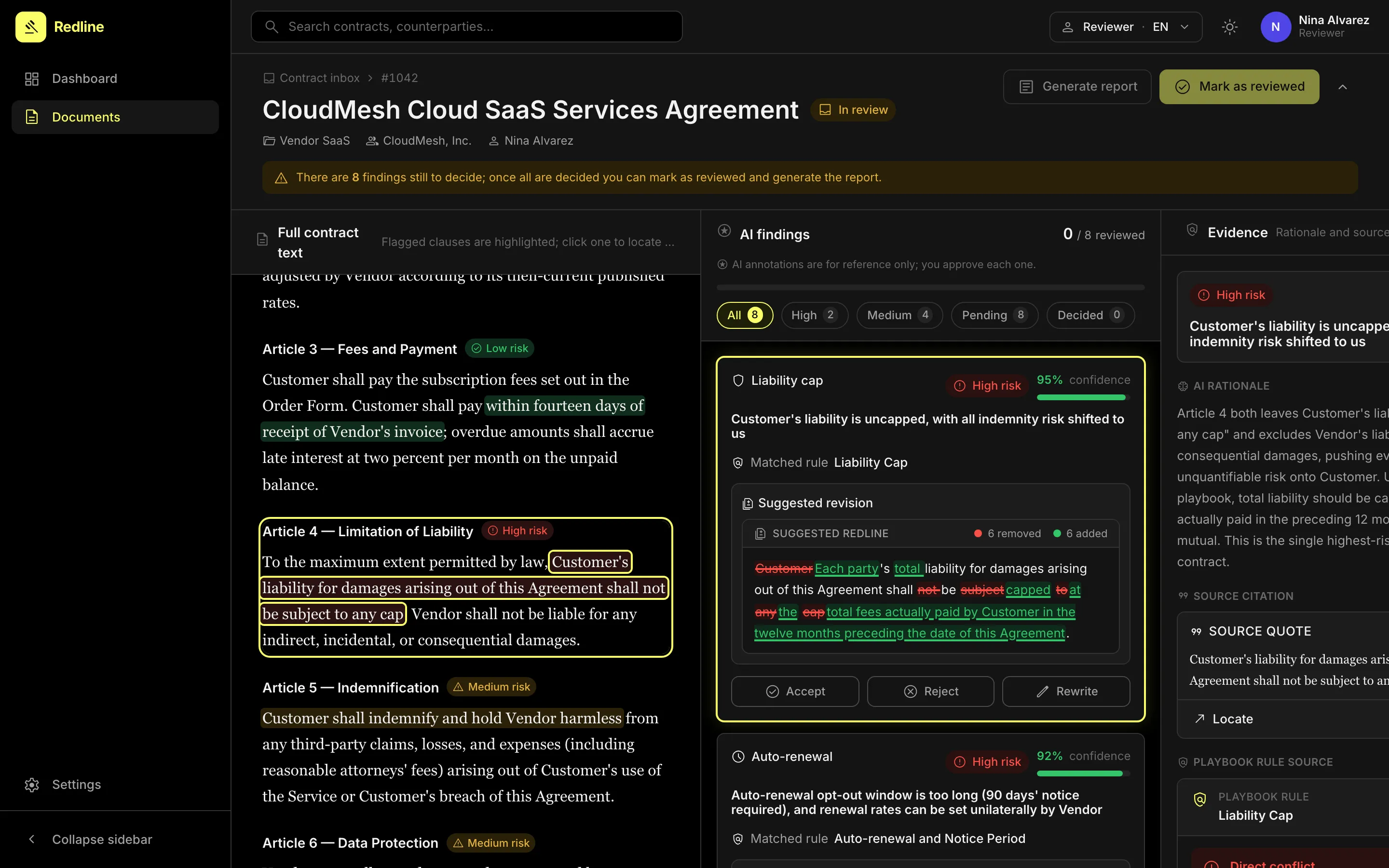
Research converged on one core persona: Nina, an operations manager—not a legal professional, but the one who has to vet the contracts the company signs. The fact that the protagonist is not a lawyer set the tone for the whole interface: the AI can’t drop a verdict and walk away; it has to act like a senior colleague willing to explain. Following that insight, I broke “trustworthy” into four decisions the interface could carry—and that could be refuted.
Outcome & Reflections
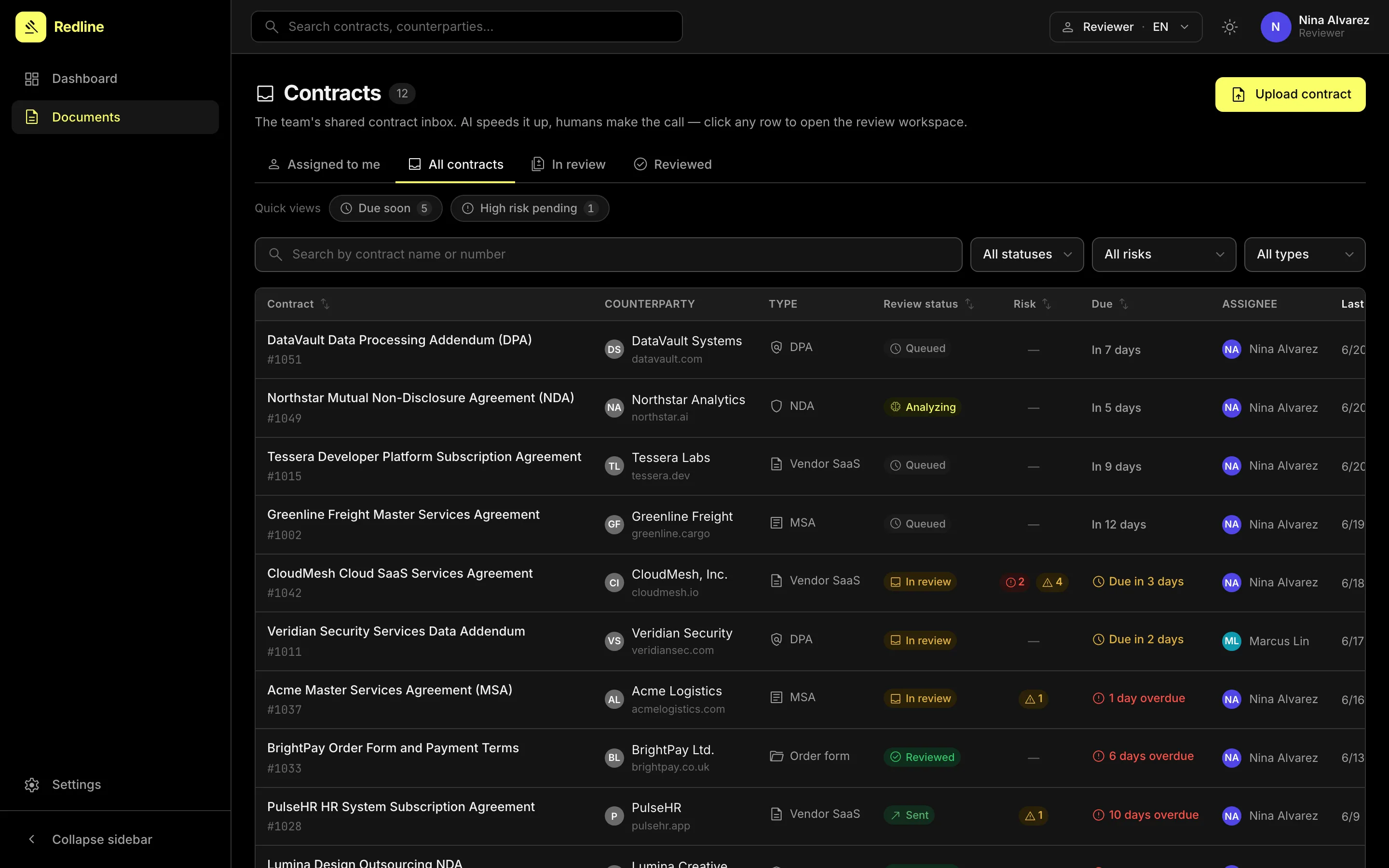
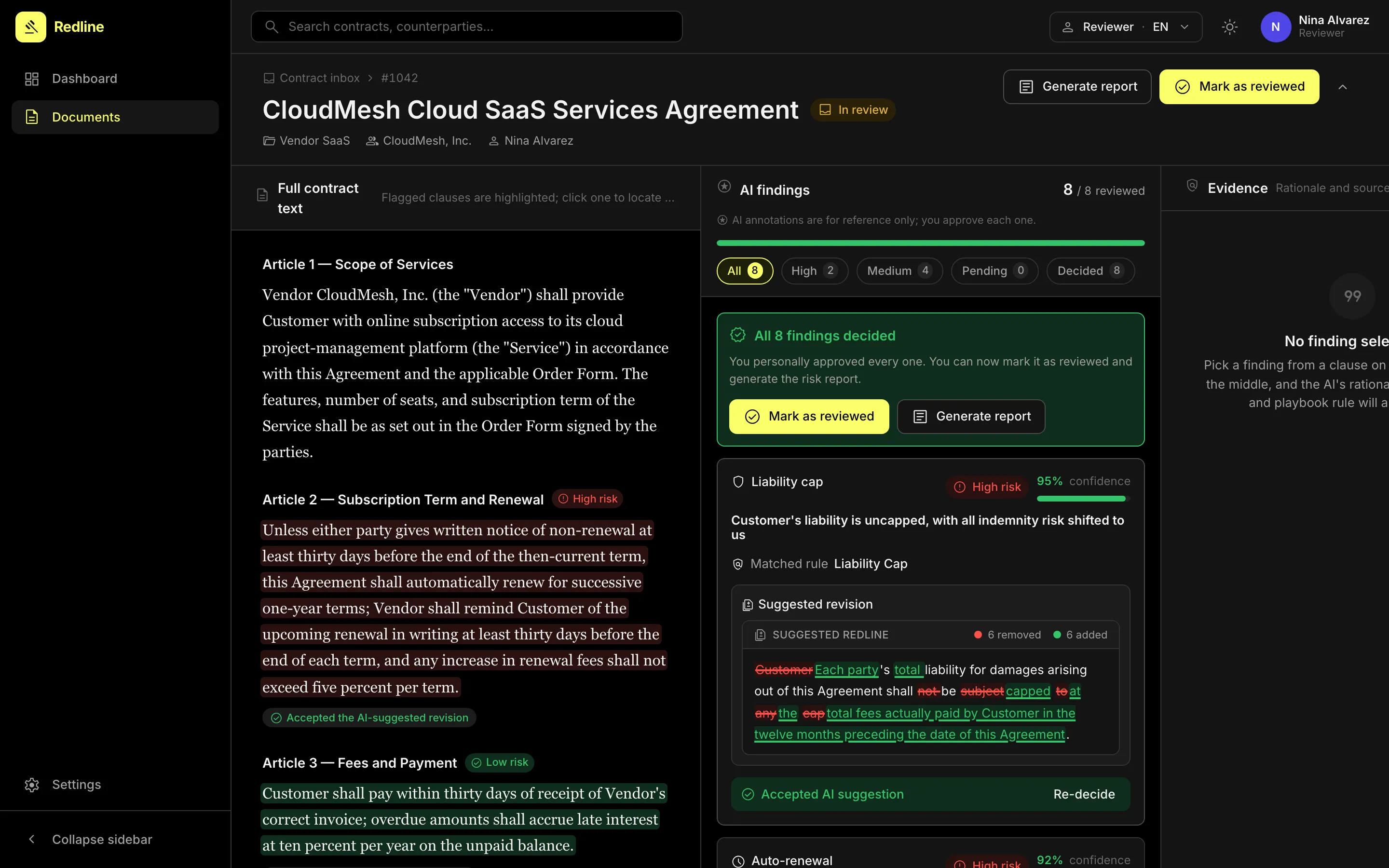
The final deliverable is a deployed interactive prototype: a contract inbox, the three-column review workspace, streaming analysis, a risk report, and an Admin Playbook—covering the full hero flow from upload → streaming AI annotation → accept/rewrite/reject clause by clause → generate report → mark reviewed. The design system lives in CSS variables with light and dark themes, and includes 11 components custom to this case (RiskBadge, ConfidenceMeter, DiffView, CitationPopover, PlaybookRef, StreamingAnalysis…).
Light
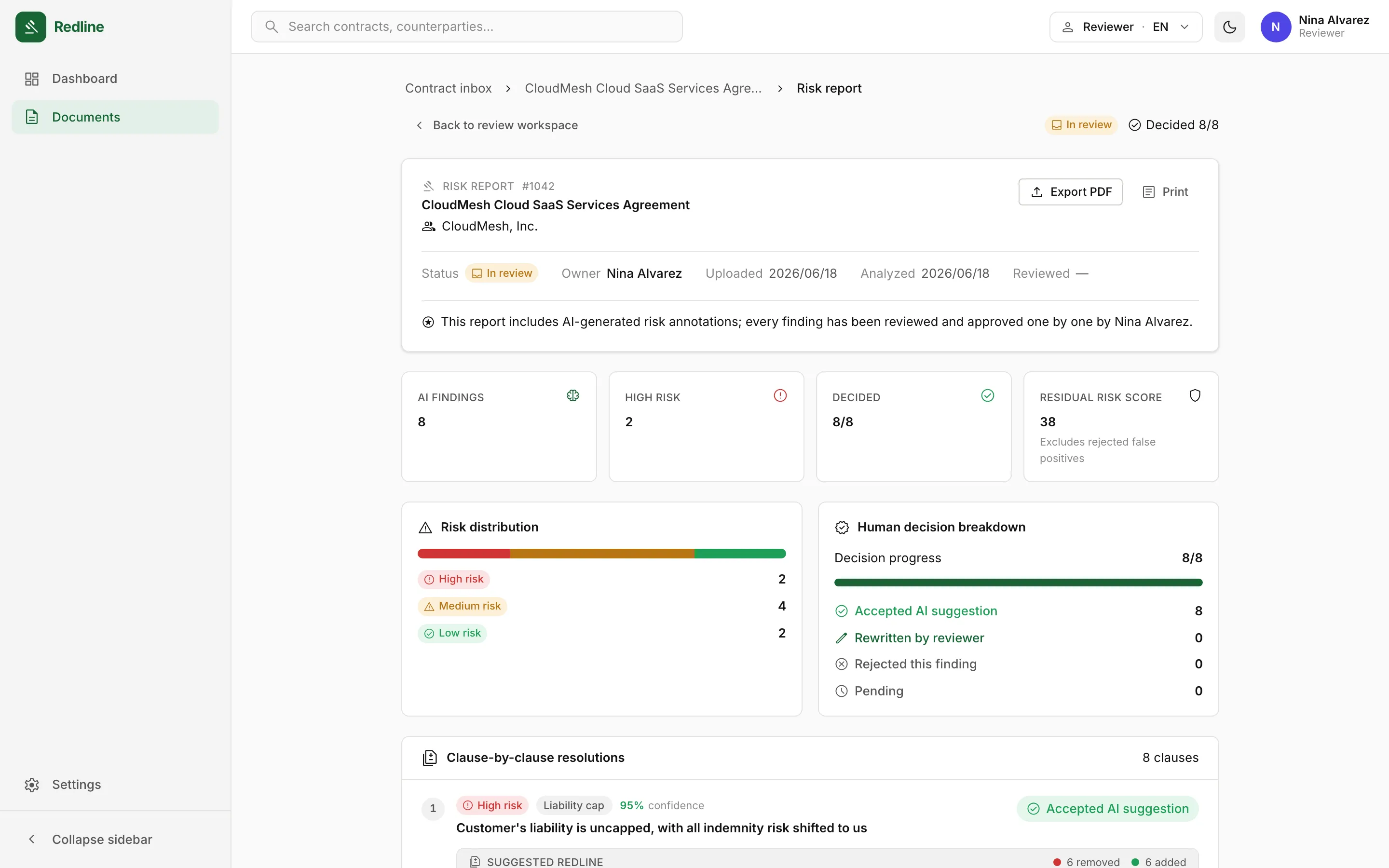
Dark
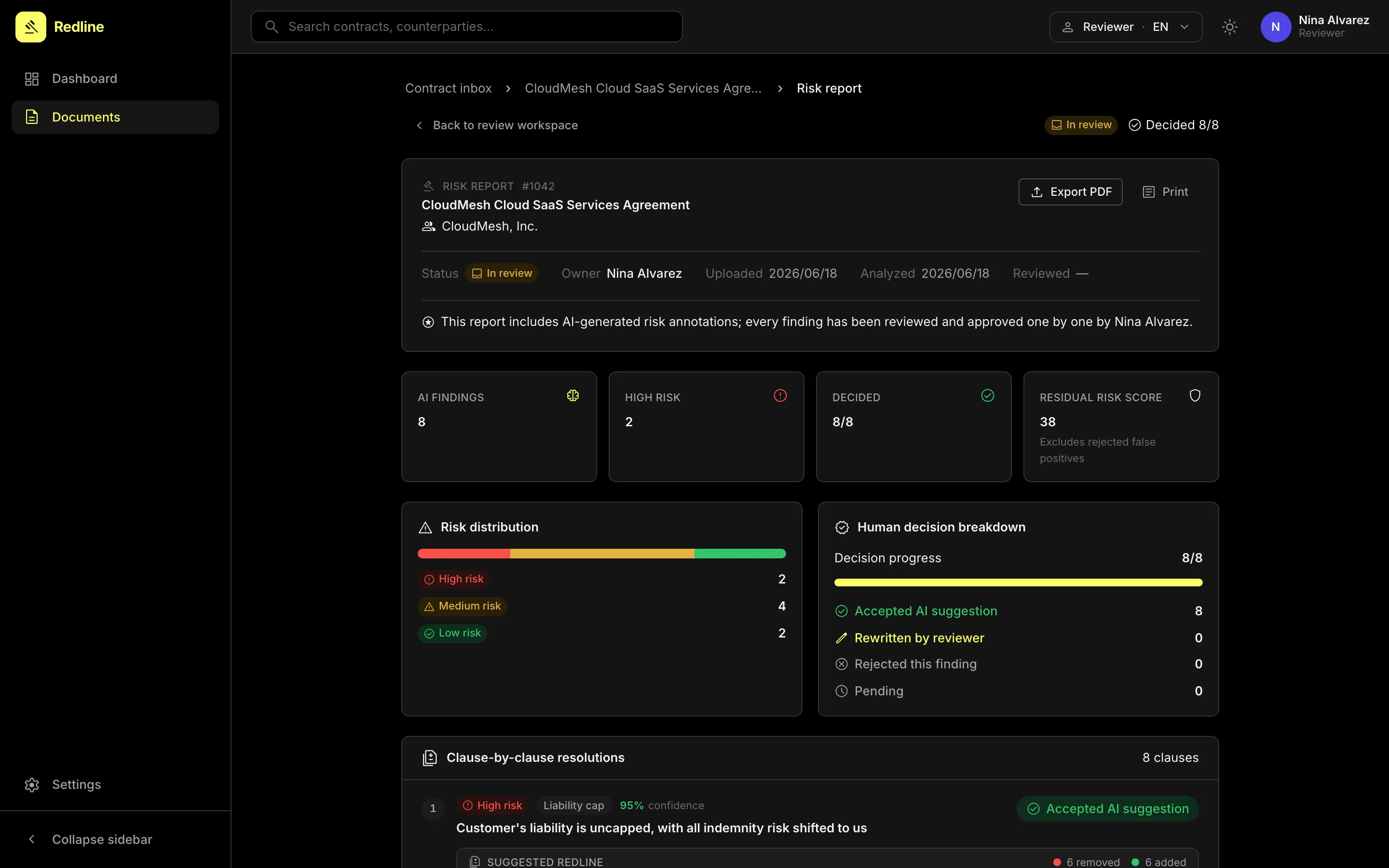
The limits are worth stating plainly. First, this runs on mock data with no real model: the eight findings are hand-authored facts, not generated on the fly—a deliberate trade-off, because pre-written fixtures are what keep the demo identical on every run and the quality controllable (that 0.45 false positive has to “happen” to exist for the story to hold). Second, there’s no real document parsing and no login/billing/e-sign; everything is bounded by “the clickable prototype that best demonstrates AI product UX thinking.”
The point of this case isn’t to ship a contract-AI product, but to demonstrate that a designer can take an abstract claim like “trustworthy AI” and break it into interface decisions that have a rationale, evidence, a confidence scale, and a human with the final say—and write that promise all the way down into the type system and the state machine, not just the screens.