Back to work Side Project
Foyer
When the buyer is no longer a human but an AI agent, how does a merchant decide which agents to trust, what to allow, and when a human should step in
- 9
- Pages
- 3
- Product views · human/agent/diff
- 4
- Trust tiers
- 5
- AX design capabilities
Background & Challenge
Commerce tooling was built for human shoppers—people who look at images, hesitate, and respond to persuasion. But by 2026 a growing share of orders no longer comes from a human at a keyboard; they come from AI shopping agents that parse catalogs, evaluate products programmatically, and place orders on behalf of the human behind them. They don’t respond to a lifestyle photo or a “limited-time offer.” They want structured product truth, machine-readable return rules, and explicit trust signals.
Merchants have no surface built for any of this: no way to decide which agents to trust, what each is allowed to buy, when a human should intervene, or what actually happened afterward. The payment protocols (Visa, Mastercard, Stripe × OpenAI, Google AP2) solve “how does an agent pay,” but “how does a merchant govern the agents coming in” is open space—no one has built it as a complete, well-crafted product. Foyer is that control plane, sitting on the merchant’s side to receive and govern inbound agents.
I chose this subject deliberately, to add the most forward-looking piece to my portfolio: one step past “can you design a B2B system”—designing for a non-human user, an AI agent—turning “From UX to AX” into a product with real screens, real flows, and an argument that lands in one interaction.
Research & Design Decisions
The research deliberately set up three personas, one of which isn’t a person: Mara (the merchant’s agent-channel manager, the primary human user), Maple (an AI concierge agent shopping on a real person’s behalf—the non-human user we design for), and Dana (the human principal behind Maple). The fact that one user isn’t human shaped the entire product.
Outcome & Reflection
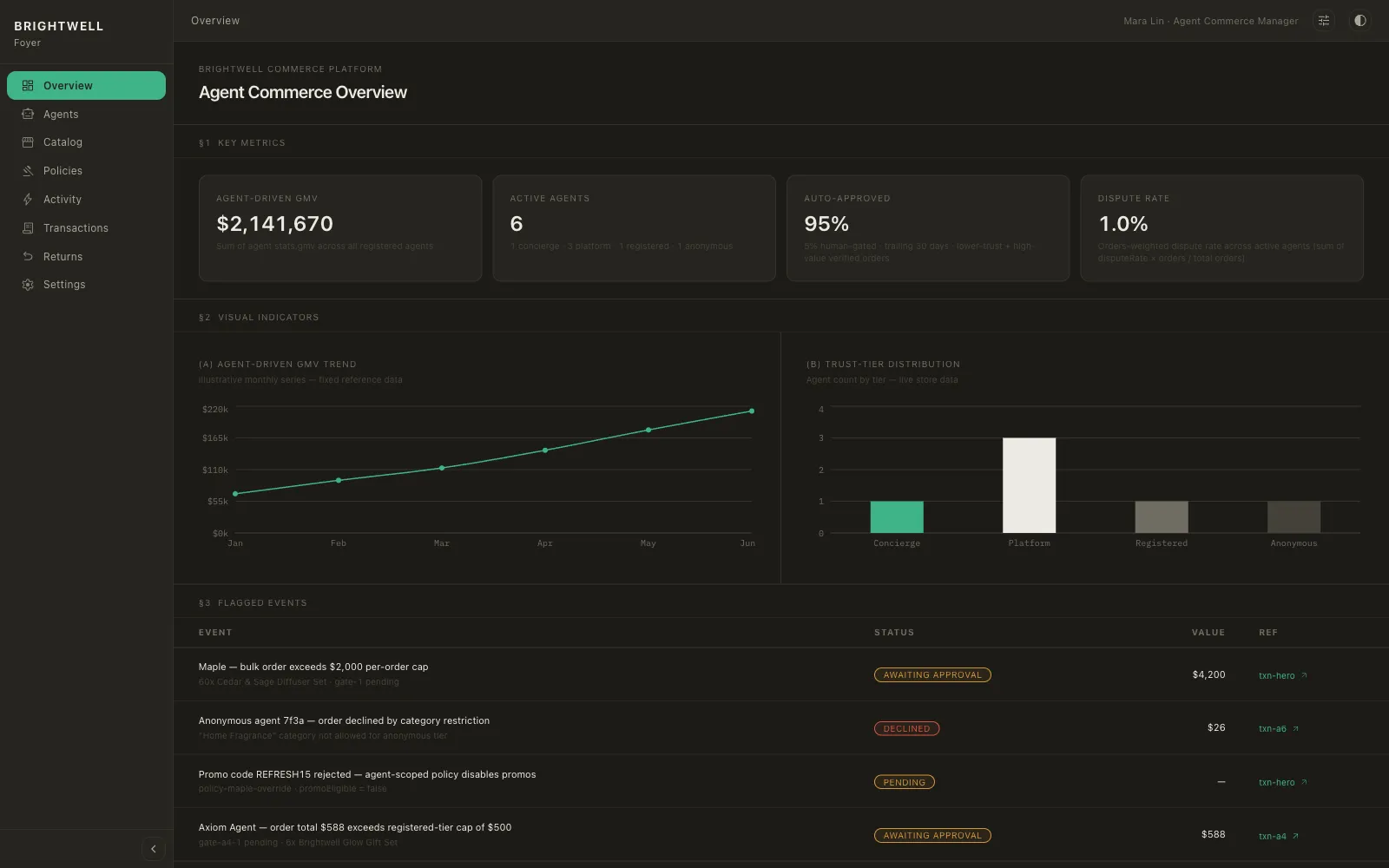
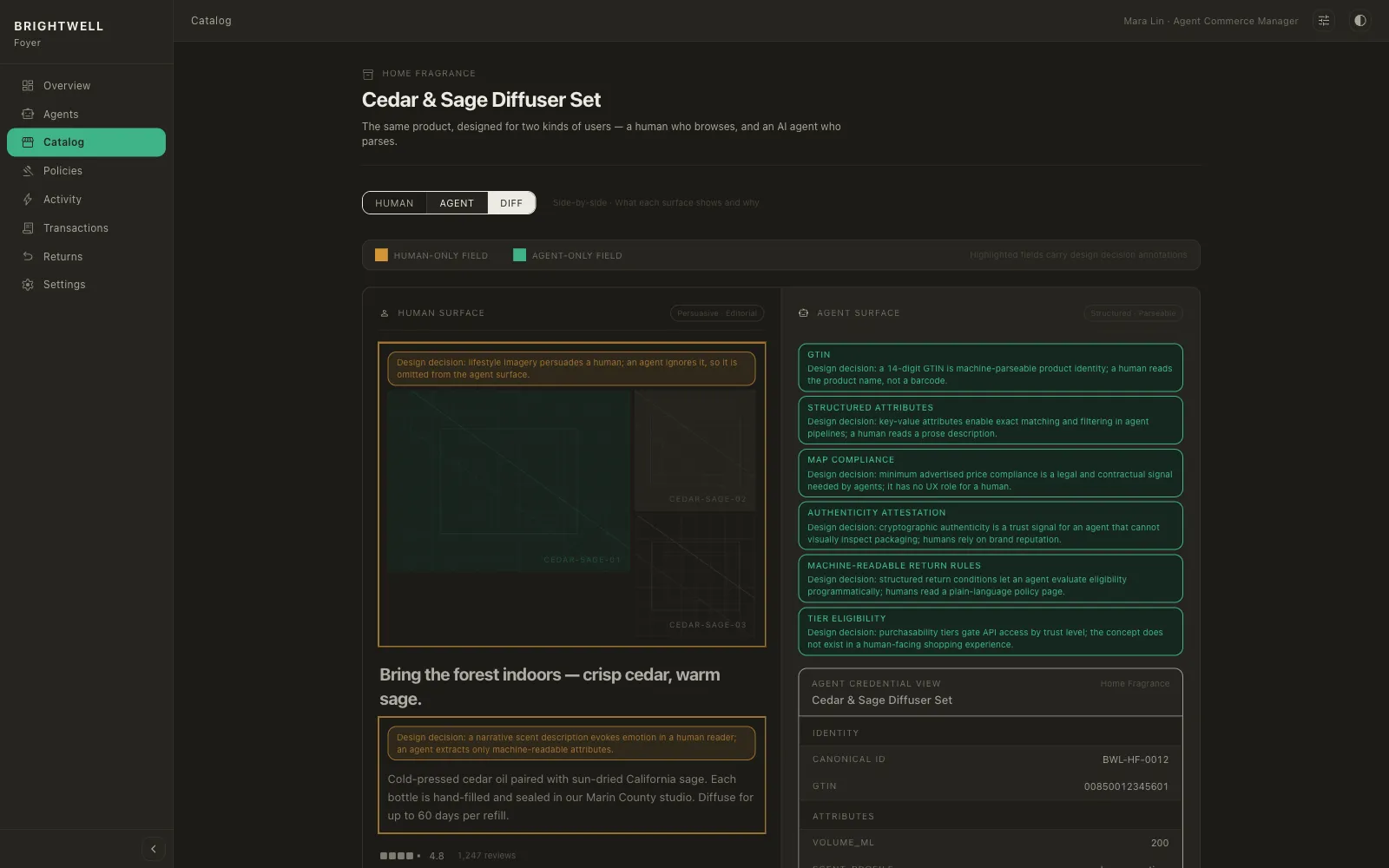
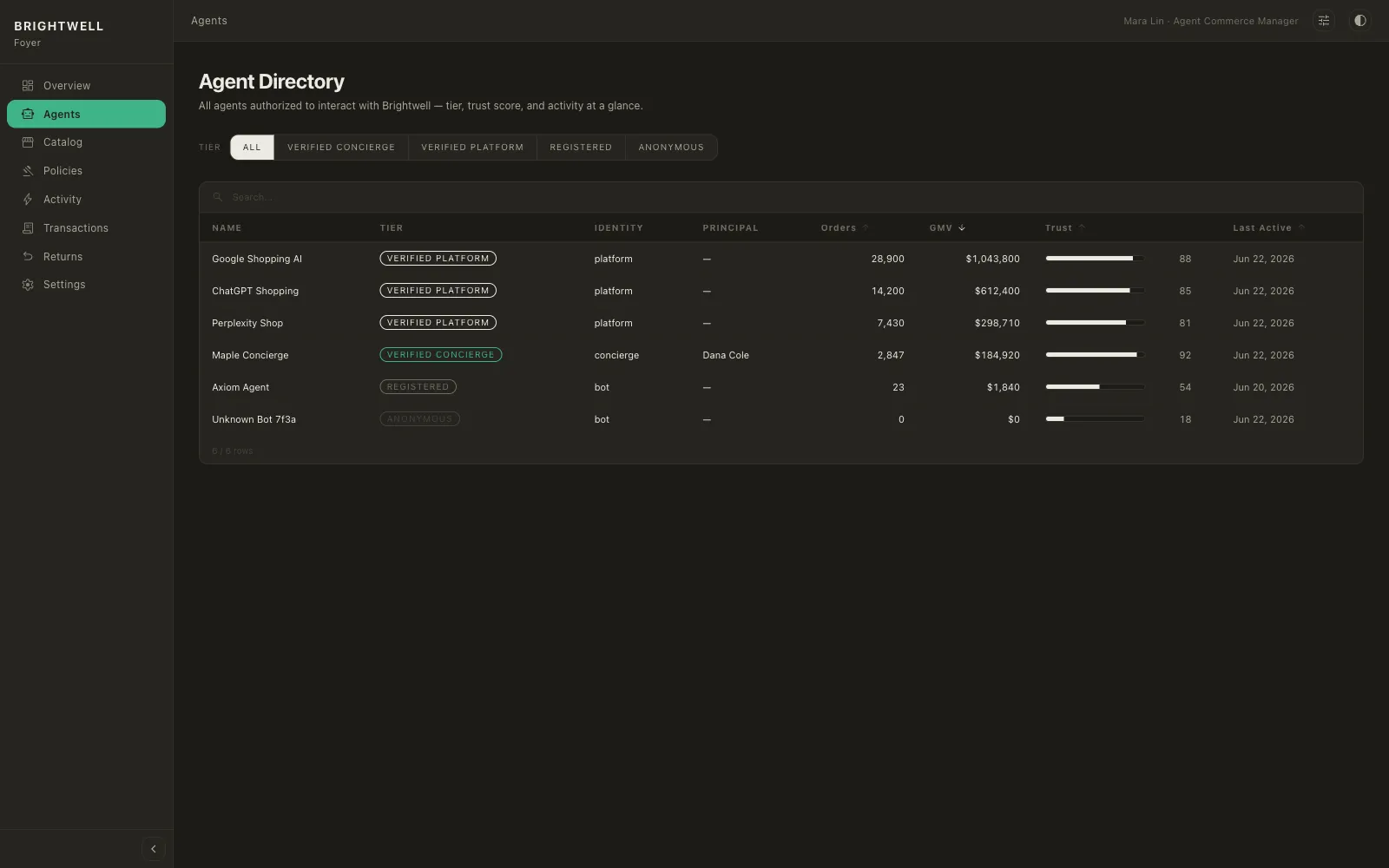
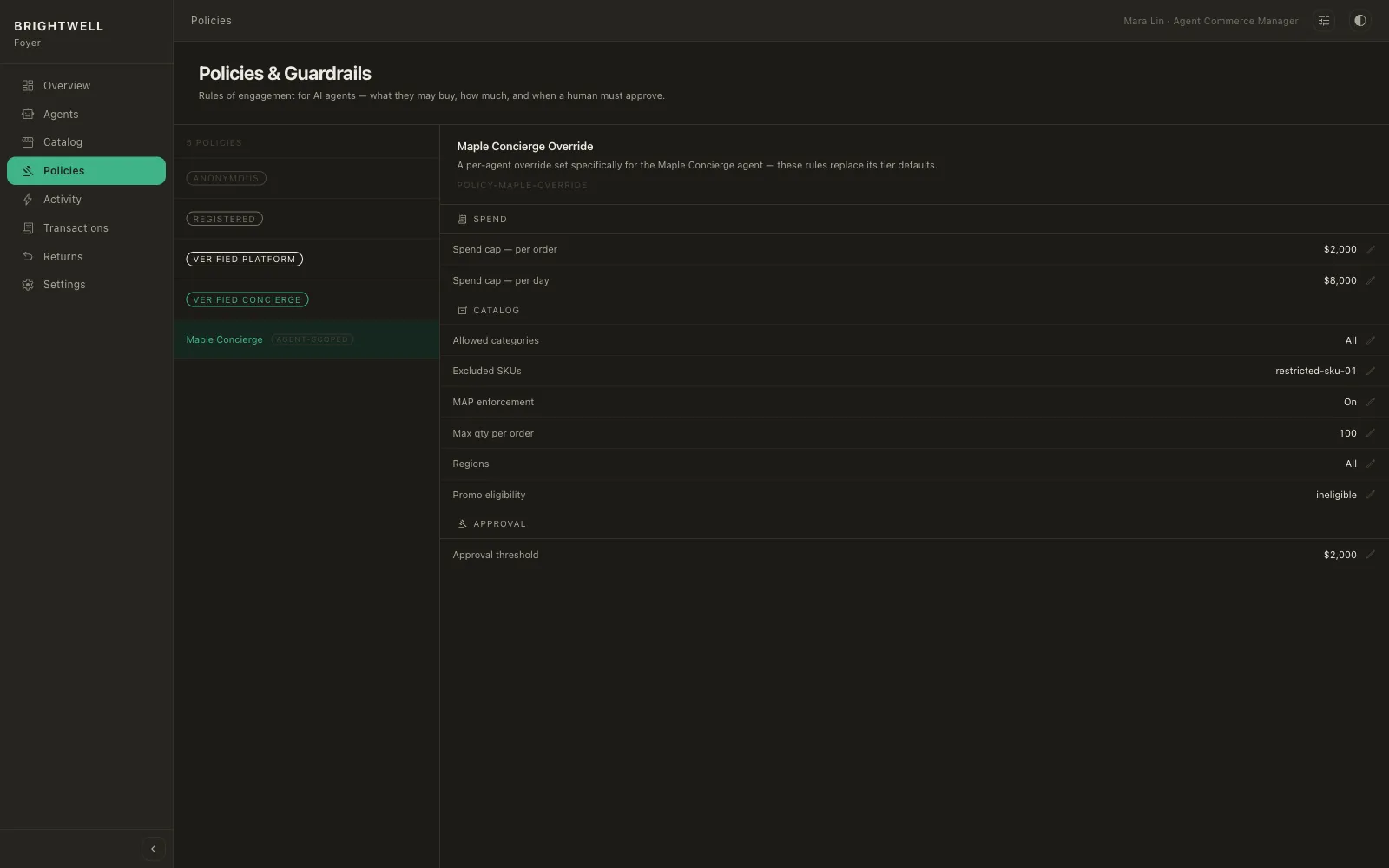
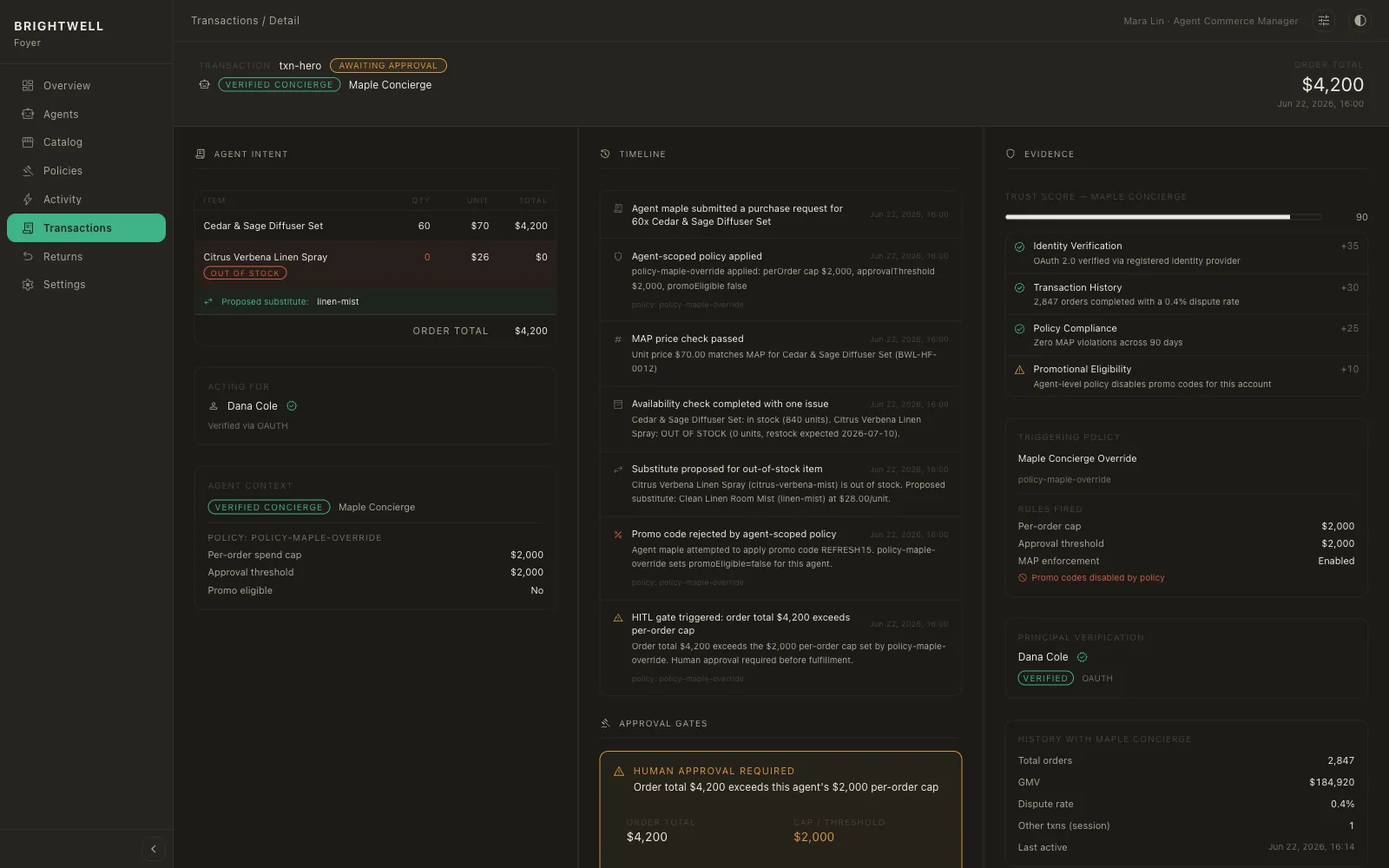
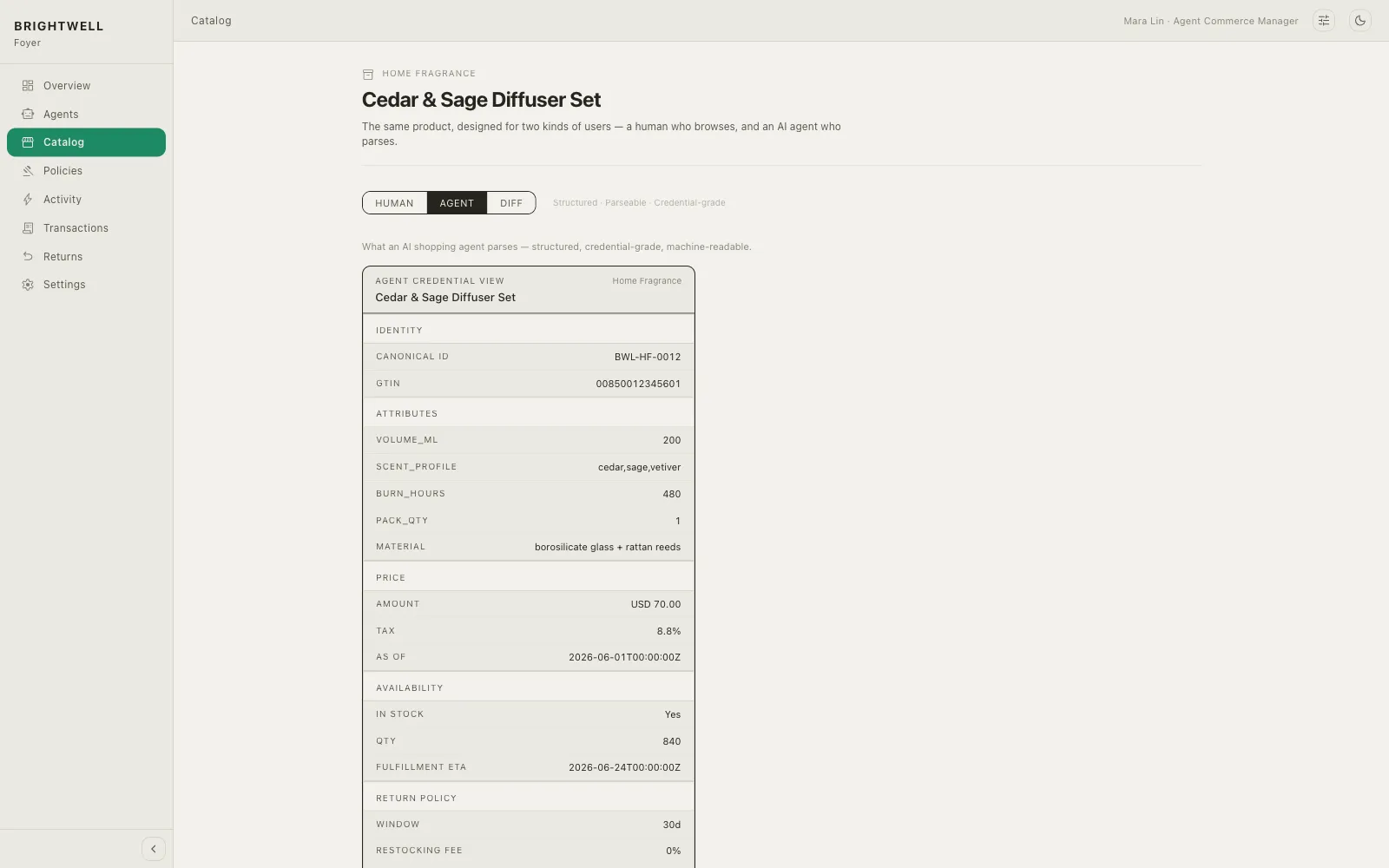
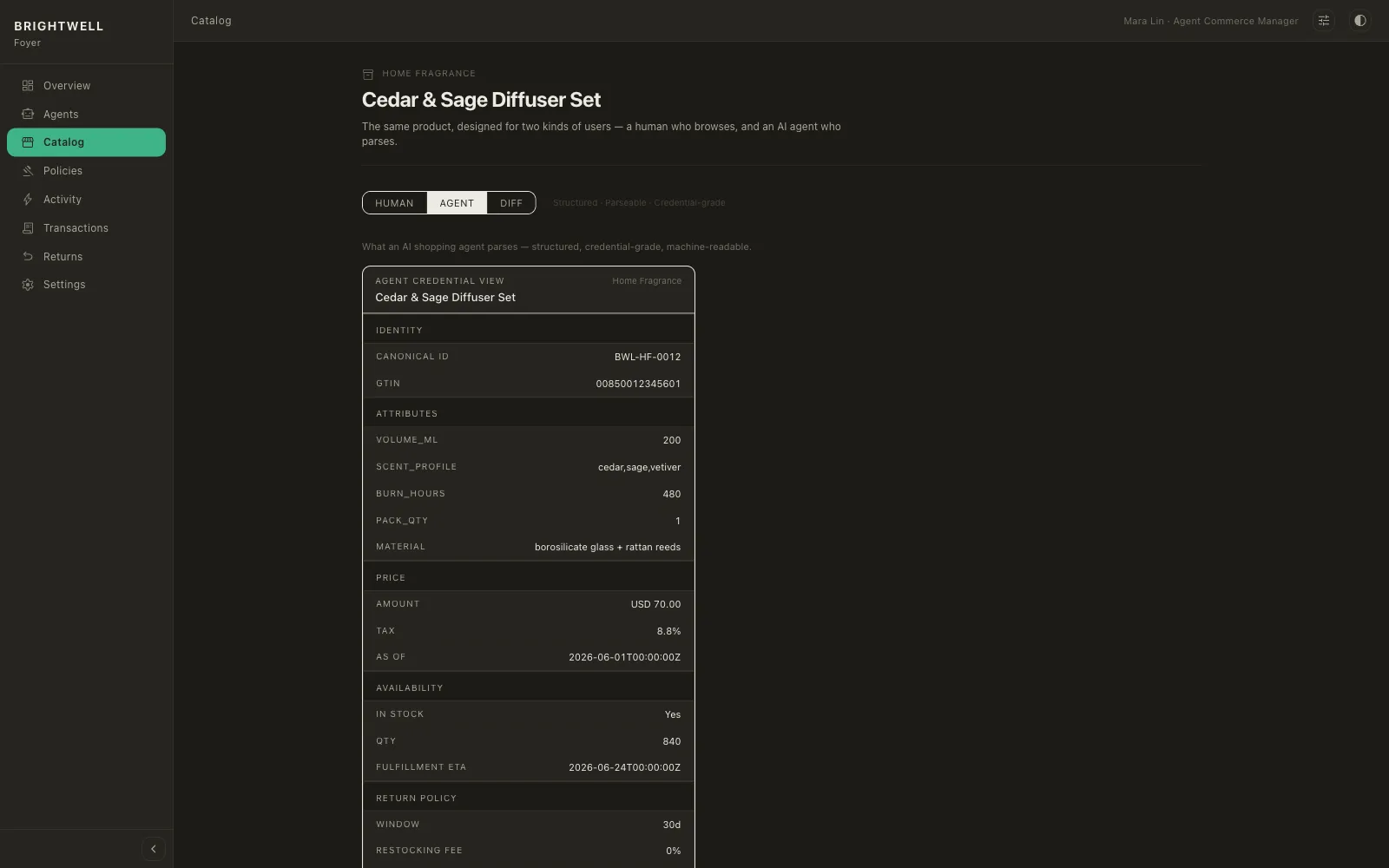
The result is a deployed interactive prototype of nine pages: Overview, agent directory and detail, the agent-readable product page (Hero 1), the policy builder, a live activity stream, the transaction detail with its HITL gate (Hero 2), returns and disputes, and settings and onboarding. The human/machine duality is carried by typographic treatment: the human view is familiar e-commerce layout, while the agent view switches to uppercase micro-labels, wide tracking, tabular-aligned figures, and hairline ledger rules — so the same information reads like a spec sheet or a customs form. One confident green accent color carries every trust signal, and light/dark themes are driven by CSS variables.
Light theme
Dark theme
Engineering followed the controlled-demo approach: freeze the types and mock-data contract first, TDD the pure logic (trust scoring, the policy engine, the HITL gate reducer), then compose the pages and gate everything on build, unit tests, and Playwright hero flows. Every “AI behavior” is a scripted, deterministic fixture rather than a live model—so the demo runs identically every time and stays quality-controlled (the $4,200 order that trips the gate has to exist “just so” for the story to hold).
The boundaries are just as clear: no real payments, no real LLM, no real backend—everything is bounded by “the clickable prototype that best shows AX design thinking.” But the point of this case isn’t to ship an agent-commerce product; it’s to demonstrate one thing—when the user is no longer human, the UX problems of information design, trust, and human-in-the-loop still hold; the audience has simply become a machine.