Back to work Side Project
TrustGuard
When an AI agent can place orders on its own, how do users let go while keeping trust and control

- 3
- Trust design principles
- 3
- Interactive scenario demos
- 60%
- Confidence alert threshold
- 5
- Research insights
Background & Challenge
When AI evolves from “assistant” to “agent”—able to rebalance your portfolio while you sleep—UX faces a new question: how do users let an AI act on its own, yet stay able to take back control at any moment? Web3 × agentic AI pushes this tension to the extreme: the AI needs enough autonomy to be valuable, yet most wallets offer nothing but a single Approve button before asking you to sign your assets away.
The research method of this case was itself an experiment. Constrained by the time and reach of a solo side project, I did not recruit real participants. Instead, I used AI to simulate three users with very different profiles—a marketing manager who never touches Web3, an engineer with three years of DeFi experience, and a freelancer with zero investment experience—conducted interviews with them and cross-synthesized the findings, supplemented by a competitive analysis of three real products: Tenderly, Rabby, and LangSmith. I have to flag this honestly: this is simulated research, not real user interviews, and it cannot replace them. But it let me converge on five insights within a week, one of which became the starting point of the design:
What users fear most is not the AI making the wrong choice, but having no chance to know about it, understand it, or stop it.
Research & Design Decisions
Following this insight, I broke trust down into three principles the interface could carry, each landing in concrete components.
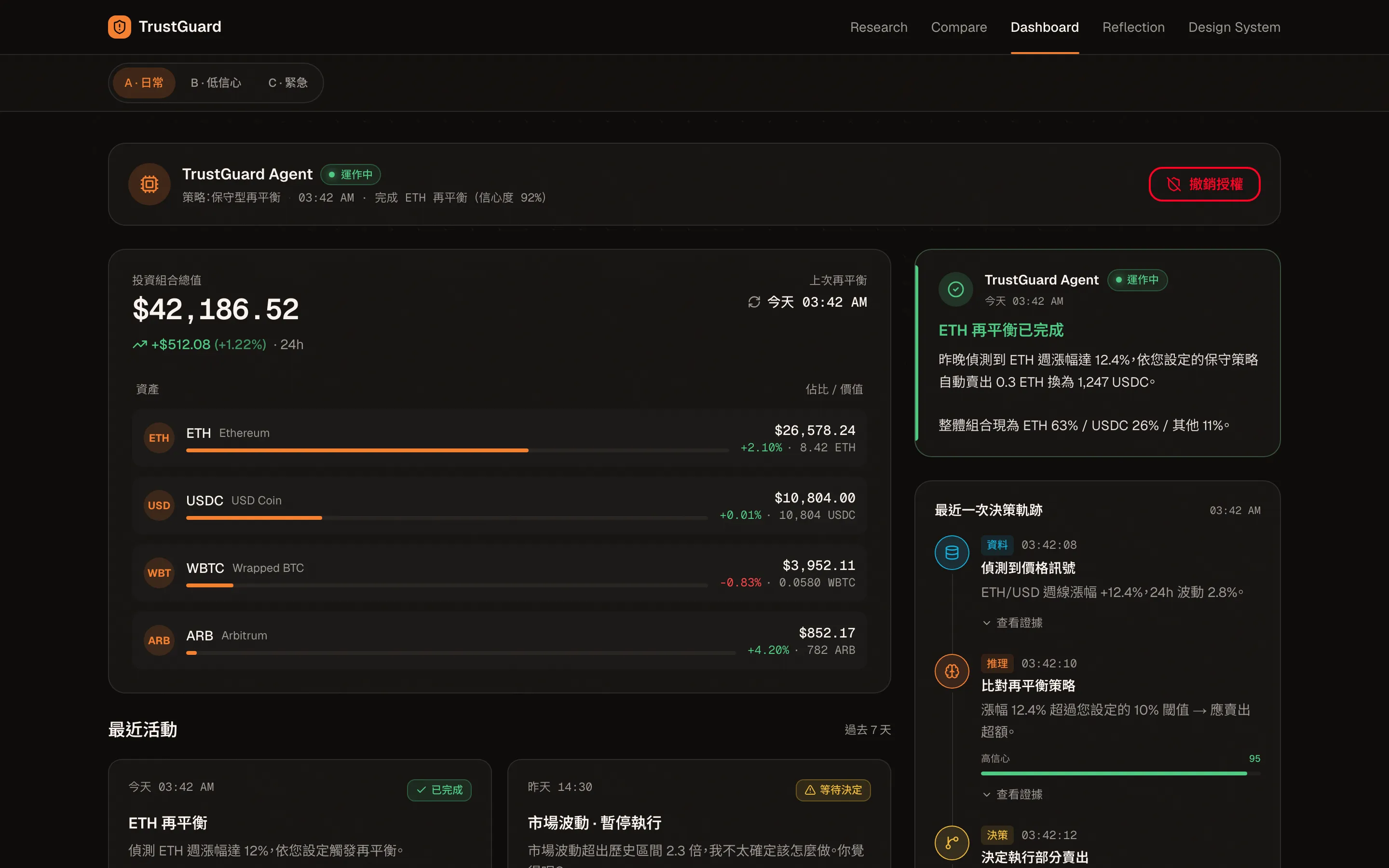
Running through every screen is “Translate, Don’t Display”: turning approve(0x1234..., uint256.max) into plain language like “the AI has been granted permanent access to your USDC.” In the simulated interviews, all three user profiles reacted the same way: when they can’t understand something, they want to close it. The translation layer thus became the product’s core differentiator.
Outcome & Reflections
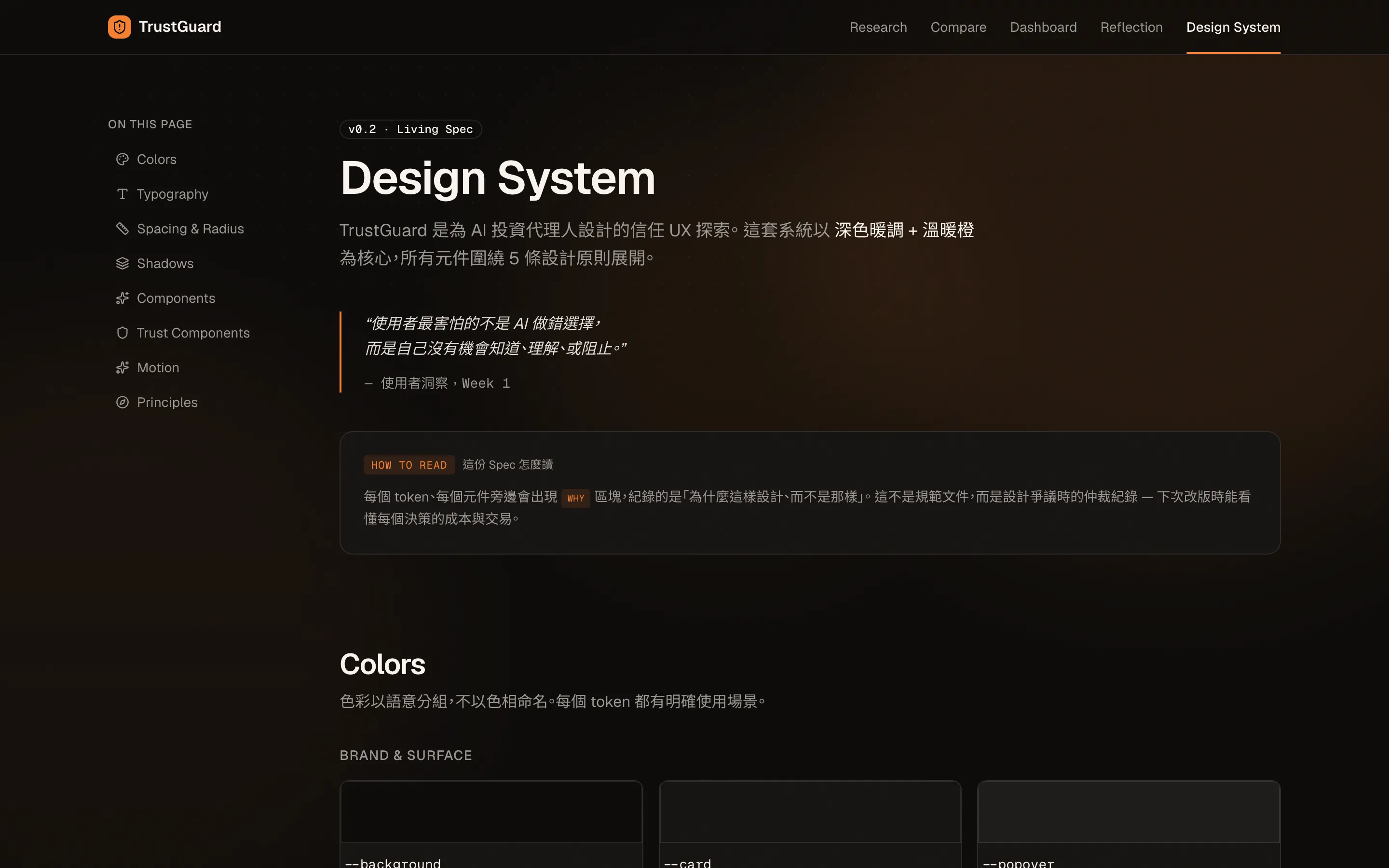
The final deliverable is a deployed interactive website: six pages and 19 custom components, including a Living Design System that lays out the “why” behind every decision, plus accessibility details such as skip links and focus-visible states. I led the design and research direction and collaborated with AI on the front-end implementation.
The reflections have to be honest, too. First, simulated research has limits: AI-simulated participants are too cooperative and never contradict themselves the way real people do—the direction of the insights is credible, but the details still need validation through real interviews. This is documented on the site’s Reflection page, and the next step is to test the three principles with real users. Second, the demo runs on mock data; the confidence scores come from a script, not real model output. Third, the process included failures and fixes: OG image generation broke because the tooling didn’t support oklch colors, and switching to hex resolved it.
The point of this case is not to ship an AI investment product, but to demonstrate that a designer can take an abstract topic like “trust” and break it into interface decisions that can be verified—and refuted—through interaction.